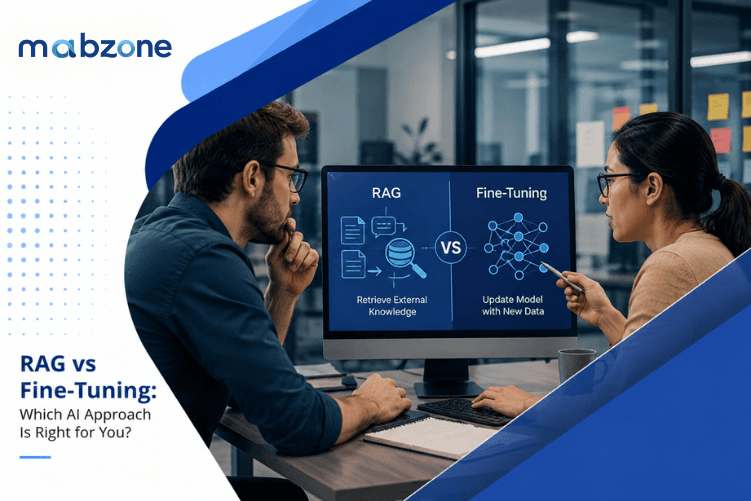
Every team building an LLM-powered product eventually hits the same decision point: should we fine-tune a language model on our proprietary data, or retrieve relevant context at query time using retrieval-augmented generation (RAG)? The question sounds simple. The answer, in practice, determines how your system behaves under load, how much it costs to maintain, and how quickly it adapts when your underlying data changes.
Neither approach is universally superior. Both have genuine strengths and genuine limitations — and the right choice depends on your product's data characteristics, latency requirements, compliance needs, and engineering capacity. Understanding the technical and operational difference is the prerequisite for making a sound decision.
How Retrieval-Augmented Generation (RAG) Works
Retrieval-augmented generation fetches relevant passages from an external knowledge base — typically a vector database — at inference time and injects them into the prompt alongside the user's query. The language model never sees your data during training. Instead, it reads fresh context with every request, like a researcher pulling source documents before drafting an answer.
Because the knowledge lives outside the model weights, it can be updated, corrected, and extended without any retraining. When a product policy changes or a new regulation is published, you update the document store and the system reflects that change immediately. Every response is grounded in specific retrieved passages, giving users traceable citations and confidence that answers come from a verifiable source — not hallucinated parametric memory.
RAG works best when: your data changes frequently (daily, weekly, or in real time); your users need to trust and verify outputs; or your corpus is large and heterogeneous. Support centres, legal research tools, internal knowledge assistants, and compliance-facing applications are natural homes for RAG architecture.
How LLM Fine-Tuning Works — And When to Use It
Fine-tuning adjusts the weights of a pre-trained model on a curated, domain-specific dataset. The model does not retrieve anything at inference time — knowledge, tone, reasoning patterns, and output format are encoded directly into its parameters during training.
The result is a model that feels native to your domain. It responds in your brand's voice, formats outputs the way your downstream systems expect, and applies specialised reasoning that a general-purpose model would need extensive prompting to approximate. For use cases where consistency, stylistic precision, and low-latency generation matter more than real-time factual accuracy, fine-tuning delivers what RAG cannot.
Fine-tuning earns its cost when: your training data is relatively stable; output format or tone is critical and cannot be reliably enforced through prompting alone; or you need the model to internalise complex domain logic specific to your industry. Medical documentation assistants, legal drafting tools, and domain-specific code generation are strong candidates.
3 Key Questions: RAG or Fine-Tuning for Your Use Case?
Rather than defaulting to one approach, answer these three diagnostic questions first:
How frequently does your data change? If your knowledge base updates daily or in real time, fine-tuning creates a retraining burden that compounds over time — every update requires a new training run or leaves the model stale. RAG separates the knowledge layer from the model, letting you update one independently of the other.
How important is source traceability? In regulated industries, users often need to know not just what the model said but exactly where the information came from. RAG provides this natively — every answer ties back to retrieved passages. Fine-tuned models blend training data into weights, making attribution fundamentally harder.
What is your tolerance for operational complexity? Fine-tuning requires labelled training data, compute budget, evaluation infrastructure, and a deployment pipeline. RAG requires a retrieval pipeline, an embedding model, and a vector database. Neither is trivial — but RAG scales more gracefully as your data volume grows.
Why Most Production AI Systems Combine RAG and Fine-Tuning
In practice, the most capable LLM-powered products in production layer both approaches. The pattern we deploy most frequently: a fine-tuned base model that has internalised the product's output format, brand voice, and domain reasoning, combined with a RAG layer that injects current, specific, verifiable facts at inference time.
The fine-tuned model handles the how — structure, consistency, reasoning style. The retrieval layer handles the what — the specific, up-to-date facts the query demands. Fine-tuned models also use retrieved context more effectively than general-purpose models, because they have learned to integrate domain-specific information coherently into their outputs.
Start With Prompt Engineering Before Committing to Either
Before investing in RAG infrastructure or a fine-tuning pipeline, it is worth establishing that prompt engineering cannot already meet your requirements. Prompt engineering carries near-zero marginal cost, is fully reversible, and requires nothing beyond an API key.
The practical sequence: start with a well-designed system prompt, validate product-market fit, then invest in RAG when data volume and update frequency justify retrieval infrastructure, and consider fine-tuning only when prompt engineering has hit a ceiling on consistency or domain accuracy. Building the most complex system first is a common and expensive mistake.
How to Choose Between RAG and Fine-Tuning
RAG gives you a living knowledge layer that updates without retraining, grounded outputs with traceable citations, and a system that handles large, evolving corpora without hitting context limits. Fine-tuning gives you a model fluent in your domain, consistent in output structure, and capable of domain-specific reasoning that prompting alone cannot reliably produce.
Understanding which properties your product actually needs — and which are merely nice to have — is what makes the architecture decision clear. At mabzone Technologies, we help product and engineering teams run this diagnostic, design the right retrieval and training infrastructure, and build LLM systems fit for production — not just a demo.
Frequently Asked Questions
What is the main difference between RAG and fine-tuning? RAG retrieves external knowledge at query time and injects it into the prompt. Fine-tuning bakes knowledge directly into the model's weights during a training process. RAG is better for dynamic, frequently updated data; fine-tuning is better for stable domain knowledge and consistent output format.
Can RAG and fine-tuning be used together? Yes — and in production, they often are. A fine-tuned model handles tone, structure, and domain reasoning, while a RAG layer injects current, traceable facts. The combination outperforms either approach alone for most complex use cases.
Is fine-tuning more expensive than RAG? Fine-tuning has a higher upfront cost — compute budget for training runs, labelled data preparation, and evaluation infrastructure. RAG has ongoing infrastructure costs for the vector database and embedding model. Over time, RAG tends to be more cost-effective for frequently changing knowledge bases.
What is a vector database and why does RAG need one? A vector database (such as Pinecone, Weaviate, or pgvector) stores documents as high-dimensional numerical embeddings and retrieves the most semantically similar ones at query time. It is the retrieval engine that makes RAG fast and accurate across large knowledge bases.
When should I start with prompt engineering instead of RAG or fine-tuning? Almost always — prompt engineering is the lowest-cost, fastest-to-validate starting point. Move to RAG when your corpus is too large for the context window or changes too frequently for prompts to stay current. Move to fine-tuning when prompting cannot reliably produce the output format or domain reasoning your product requires.