Computer Vision That Works On Your Data,
In Your Environment
Object detection, defect inspection, OCR, video analytics, and custom model training — we build vision systems that perform on your real-world data and deploy cleanly on cloud or edge hardware.
What we build
End-to-end computer vision services
From raw image data to deployed production models — every capability in the vision stack, built for your specific task and hardware constraints.
Object Detection & Recognition
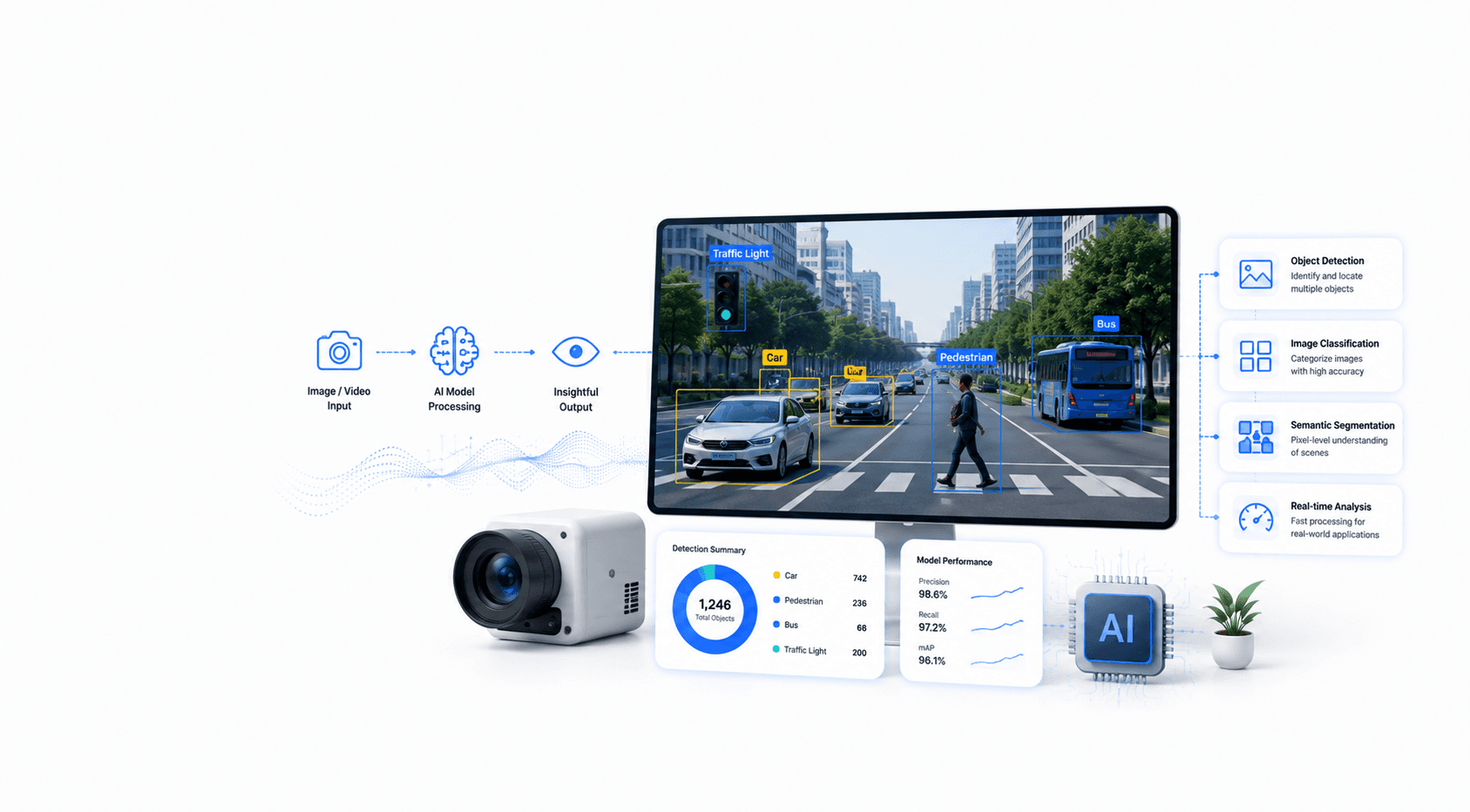
Real-time detection and classification of objects within images and video streams — built on YOLO, DETR, or custom architectures, tuned to your class set and latency budget.
Image Classification
Single-label and multi-label classifiers trained on your proprietary data — fine-tuned from ResNet, ViT, or EfficientNet backbones with calibrated confidence scores for production use.
Image & Instance Segmentation
Pixel-level segmentation for semantic, instance, and panoptic tasks — enabling precise boundary detection, measurement, and region-based analysis beyond bounding boxes.
OCR & Document Intelligence
Text extraction from scanned documents, forms, invoices, and handwriting — with structure recognition that preserves tables, headers, and field relationships for downstream processing.
Video Analytics & Tracking
Multi-object tracking, activity recognition, and temporal event detection across video streams — processing live feeds or stored footage at scale with frame-accurate output.
Defect Detection & Quality Inspection
Automated visual quality control for manufacturing and processing lines — detecting surface defects, dimensional anomalies, and assembly errors with consistency no human inspector can match.
Pose Estimation & Gesture Recognition
Human pose estimation and gesture tracking for sports analytics, physiotherapy, workplace safety monitoring, and gesture-driven interfaces — built for both real-time and batch processing.
Custom Model Training & Fine-Tuning
Training pipelines built around your labelled dataset — architecture selection, augmentation strategy, hyperparameter optimisation, and iterative evaluation until production accuracy targets are met.
Edge & On-Device Deployment
Model quantisation, pruning, and ONNX or TensorRT export for deployment on edge hardware — NVIDIA Jetson, Raspberry Pi, mobile devices, or custom embedded systems — without cloud dependency.
Where computer vision delivers value
Automation where human inspection doesn't scale
Vision models work around the clock, at line speed, with consistent accuracy — applied across the industries where visual data is the bottleneck.
Manufacturing
Automated visual inspection of production lines — catching surface defects, dimensional errors, and assembly faults at line speed with sub-millimetre precision.
Retail
Shelf compliance monitoring, product recognition for checkout-free stores, and foot-traffic heatmaps that inform merchandising decisions.
Healthcare
Medical image analysis for radiology and pathology — detecting anomalies in X-rays, MRI scans, and histology slides as a second-opinion decision-support tool.
Security & Safety
Perimeter intrusion detection, access control, PPE compliance monitoring, and unsafe behaviour alerts across CCTV and IP camera networks.
Agriculture
Crop health monitoring, disease detection, and yield estimation from drone and satellite imagery — enabling early intervention before losses become visible.
Logistics
Package damage detection at intake, inventory counting via aerial or warehouse cameras, and document verification for shipping and customs processing.
99%+
Defect detection accuracy
<10ms
GPU inference latency
1B+
Images processed in production
Cloud & Edge
Deployment flexibility
Problem Definition & Data Audit
Step 01Define the vision task precisely — classes, acceptable false-positive rate, inference latency — and audit the labelled data you have versus what's needed.
Dataset Preparation & Annotation
Step 02Clean, balance, and augment your dataset; build or manage annotation pipelines with quality control so labels reflect real production conditions, not ideal ones.
Architecture Selection & Training
Step 03Benchmark off-the-shelf models against your data before committing to a custom architecture — then train, evaluate, and iterate until accuracy targets are met.
Edge Case Testing & Hardening
Step 04Stress-test against lighting variation, occlusion, motion blur, class imbalance, and distribution shift — the failure modes that only appear after deployment.
Deployment & Drift Monitoring
Step 05Export to ONNX or TensorRT for your target hardware, instrument prediction confidence and class distribution, and alert when production drift signals retraining is due.
Have a visual inspection or recognition problem to solve?
Share your use case and data situation — we'll scope a vision architecture and show you what's achievable within two weeks.
Technologies
Our computer vision stack
PyTorch
Framework
TensorFlow
Framework
OpenCV
Vision
YOLO v11
Detection
Hugging Face
Models
ONNX
Inference
TensorRT
Optimisation
Roboflow
Dataset
NVIDIA CUDA
GPU
Python
Language
FastAPI
Backend
AWS Rekognition
Cloud AI
Why mabzone CV
What makes our vision systems production-ready
Accuracy on your data, optimised for your hardware, with edge cases handled before go-live — not after.
Production accuracy, not benchmark accuracy
We measure on your data distribution, your lighting conditions, and your edge cases — not on the dataset the paper was evaluated on.
Inference optimised for your hardware
Whether you're running on cloud GPUs, edge nodes, or embedded devices, we optimise the model for your target platform — not the nearest convenient default.
Data strategy built in from the start
Label quality and dataset composition determine model quality more than architecture. We treat data engineering as a first-class deliverable, not a one-time pre-processing step.
Evaluation-driven model selection
We benchmark candidate architectures on your data before committing — architecture decisions are backed by numbers, not framework familiarity.
Edge cases handled before go-live
We build adversarial test suites covering lighting variation, occlusion, motion blur, and class imbalance — so failure modes are found in evaluation, not in production.
Compliance & Standards
Compliance Standards That Shape Our Computer Vision Practice
We build vision systems within the privacy, safety, and AI accountability frameworks that regulated industries require — especially where biometric or medical data is involved.
GDPR (EU)
Lawful processing of images containing personal data and biometric identifiers
EU AI Act
High-risk classification compliance for biometric and safety-critical vision systems
HIPAA
Protected health information controls for medical imaging applications
NIST AI RMF
Risk management framework for trustworthy vision model deployment
ISO/IEC 42001
AI management system standard for vision model governance
SOC 2 Type II
Security and availability controls for vision infrastructure and image storage
IEC 62443
Industrial cybersecurity standard for vision systems in OT environments
ISO 27001
Information security management for image data pipelines and model infrastructure
CCPA
Consumer data rights for vision applications processing California residents' images
IEEE 7000
Ethical design standards for vision systems affecting human behaviour and safety
Computer Vision FAQs
Common questions about building and deploying vision models for production use cases.

Let's Build Together
Which visual inspection problem should be automated first?
Tell us your use case and existing data situation — we'll scope the architecture and show you what's achievable within two weeks.