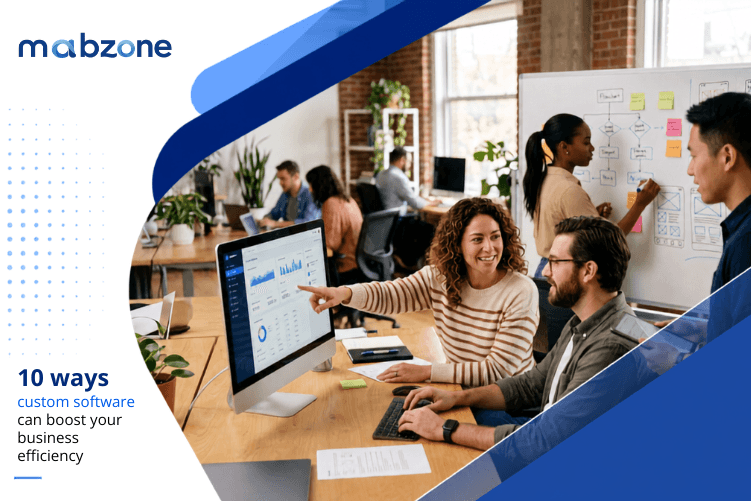
In today's fast-moving digital landscape, clinging to outdated processes is a strategic liability. Efficiency is the dividing line between businesses that scale and businesses that stall. While many organisations reach for off-the-shelf software as a quick fix, custom software delivers a fundamentally different advantage — it is built around your workflows, your rules, and your goals, not someone else's.
Here are ten concrete ways custom software can transform business efficiency in 2025 and beyond.
1. Software That Mirrors Your Business — Not the Other Way Around
Generic software is built for the widest possible market, which means it carries features you will never touch and lacks capabilities you actually need. Custom solutions are designed from the ground up to reflect your specific processes, industry requirements, and operational logic. Every screen, workflow, and integration is deliberate.
This precise alignment eliminates the workarounds, the spreadsheet patches, and the manual steps that silently consume hours each week. Your team learns the tool faster because it already thinks the way they do — resulting in shorter onboarding cycles, higher adoption rates, and productivity gains that compound over time.
2. Automating Repetitive Work So Your Team Can Focus on What Matters
Manual data entry, routine report generation, invoice chasing, and status update emails are not where your team's talent should go. Custom automation pipelines handle these tasks in seconds — reliably, consistently, and without the errors that inevitably creep into manual work.
When repetitive processes run automatically, your people are freed for the work that actually requires human judgment — strategy, client relationships, product thinking, and creative problem-solving. The downstream effects are significant: cleaner data, fewer compliance issues, faster turnaround times, and a team that feels less ground down by administrative drag.
3. Centralising Data for Sharper, Faster Decisions
When critical information is scattered across a CRM, an ERP, a separate HR platform, and a handful of spreadsheets, decision-making slows to a crawl. Leaders end up working from data that is hours or days old, pieced together from multiple sources that rarely agree with each other.
Custom software pulls every data stream into a single, unified interface that updates in real time. Operational leaders can see the full picture at a glance — revenue, pipeline, inventory, staffing, and customer activity — all from one dashboard. Decisions are faster, better informed, and based on what is actually happening rather than last week's export.
4. Clean Integration with the Tools You Already Depend On
A common concern when investing in new software is losing the tools and workflows that already work well. Custom development eliminates that trade-off. Your new platform can be built to integrate directly with your existing accounting system, payment gateway, logistics software, or any third-party API your business relies on.
Rather than replacing what works, custom integration extends and connects it — creating a coherent ecosystem where data flows where it needs to go without manual intervention. The result is continuity for your team and a compounding return on every tool in your stack.
5. Eliminating Duplicate Work Across Departments
In organisations where systems do not communicate, the same data gets entered multiple times across different platforms. Sales logs a deal in one system; finance re-enters it in another; operations updates a third. Each duplication is a source of errors, delays, and wasted effort.
Custom software eliminates this by creating a single source of truth. When a record is created or updated in one part of the platform, every connected function sees it immediately. Cross-departmental friction drops sharply, handoffs become cleaner, and the hours previously spent reconciling discrepancies are redirected to productive work.
6. Infrastructure That Scales Without Breaking
Off-the-shelf software is often built to a fixed performance ceiling. When your user base grows, transaction volumes increase, or a new product line demands additional functionality, the cracks appear — slower load times, hit limits on records or users, and costly licence tier jumps.
Custom solutions are architected to scale with your trajectory. Whether you are onboarding a new team, entering a new market, or processing ten times last year's order volume, the platform accommodates the growth without emergency upgrades or disruptive migrations. You build once for where you are going, not just where you are today.
7. Security Designed for Your Risk Profile
Data breaches are not only expensive to remediate — they inflict lasting damage on customer trust and brand reputation. Off-the-shelf platforms apply the same security configuration to every customer in their user base. Your business may have compliance requirements, data sensitivity levels, or regulatory obligations that a generic product simply cannot address.
Custom software lets you define the security architecture from the start. Encryption standards, multifactor authentication flows, role-based access controls, audit logging, and data residency requirements are all built to your specification. The outcome is a platform that protects your data precisely, without forcing your team through unnecessary friction to do their daily work.
8. Reducing Operating Costs Through Smarter Workflows
The upfront investment in custom software is often the figure that gives finance teams pause. The total cost picture, however, looks very different when you account for what is eliminated — redundant SaaS subscriptions, manual labour hours spent on tasks a system should handle, and the accumulated cost of errors that travel downstream before anyone catches them.
Purpose-built workflows remove the inefficiency that inflates operating costs quietly and persistently. Over a twelve-month horizon, the savings in staff time alone frequently justify the development investment. Beyond that, the platform continues delivering returns for years without the per-seat pricing increases that characterise off-the-shelf alternatives.
9. Giving Customers an Experience Worth Coming Back For
Modern customers compare every digital interaction against the best they have experienced anywhere — not just in your industry. Slow portals, generic communications, and support teams working from incomplete information are all reasons customers quietly stop returning.
Custom software lets you build the customer-facing experience around what your clients actually need. Personalised dashboards, proactive notifications, seamless self-service options, and support teams equipped with complete interaction history all contribute to a service experience that feels considered rather than cobbled together. Customers who feel well served stay longer, spend more, and refer others.
10. Building a Platform That Evolves With the Market
Technology moves quickly. AI capabilities that were experimental two years ago are now production-ready. Regulatory requirements shift. Customer expectations raise the bar annually. Off-the-shelf software vendors release updates on their own schedule — which may not align with when you need them.
Custom software can be extended, refined, and retooled on your timeline. When a new capability becomes relevant — whether that is AI-driven analytics, IoT device integration, or a new compliance framework — your platform can absorb it without a disruptive platform migration. You remain adaptable by design rather than constrained by someone else's product roadmap.
The Compounding Return of Building Right
Real business efficiency is not simply doing things faster. It is doing the right things in the right order, with the right information, and the capacity to change direction when circumstances demand it. Custom software development channels technology directly into your operational vision — removing friction and opening paths that off-the-shelf tools cannot reach.
At mabzone Technologies, we build custom software solutions that solve today's problems while remaining ready for tomorrow's demands. Whether the priority is business process automation, tighter integration, a better customer experience, or a scalable platform, we work with you to design and deliver it — so your operations become a competitive advantage rather than a constraint.
Frequently Asked Questions
What is custom software development? Custom software development is the process of designing, building, and deploying software tailored to a specific organisation's workflows, processes, and requirements — as opposed to purchasing off-the-shelf software built for a general market.
How does custom software improve business efficiency? Custom software eliminates the workarounds, manual steps, and integration gaps that off-the-shelf tools create. By automating repetitive processes, centralising data, and fitting precisely to existing workflows, it reduces wasted time and error rates while accelerating decision-making.
What is the ROI of custom software development? ROI varies by use case but most organisations see payback within 12–24 months through reduced manual labour costs, fewer errors, eliminated SaaS subscription overlaps, and improved operational throughput. The return compounds year on year as the platform continues delivering without per-seat pricing increases.
How long does it take to build custom software? A focused MVP addressing a specific process problem can be delivered in 8–16 weeks. More complex, enterprise-wide platforms typically require 6–18 months depending on integration complexity and scope. The timeline is directly tied to how well requirements are defined at the outset.
When should a business choose custom software over off-the-shelf? When no existing product covers the specific workflow without significant workarounds; when the processes being supported are a genuine source of competitive advantage; when integration requirements are complex; or when the long-term cost of licensing seats in a generic tool exceeds the cost of building a purpose-built system.