There is a category of SaaS architecture decisions that engineers make under time pressure in the early weeks of a project — decisions that feel tactical and temporary but turn out to be structural and permanent. Multi-tenancy is the most consequential of them.
How you isolate tenant data, structure your database, handle tenant-specific customisation, and enforce access boundaries shapes your product's security posture, your ability to win enterprise deals, your compliance readiness, and your database performance for the entire life of the product. Getting these decisions right early is far cheaper than trying to change them later.
What Is Multi-Tenant Architecture in SaaS?
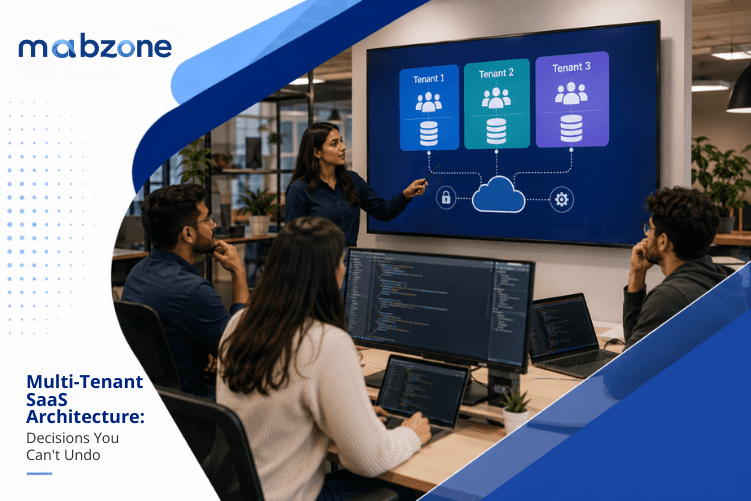
Multi-tenancy is the architectural pattern where a single instance of a software application serves multiple customers — called tenants — whose data is kept separate and secure from one another. Most B2B SaaS products are multi-tenant by design: one deployment, one codebase, one infrastructure stack, but isolated experiences and data for each customer organisation.
The alternative — single-tenant architecture, where each customer gets their own dedicated deployment — is used in specific contexts (sovereign cloud requirements, extreme customisation needs, heavily regulated verticals) but carries infrastructure and operational costs that make it impractical as a default for most SaaS businesses.
The Three Tenant Isolation Models: Trade-offs Explained
The foundational multi-tenant architecture decision is how to isolate tenant data at the database layer. There are three primary models, each with a distinct profile of cost, scalability, security, and migration complexity.
Shared schema with row-level security is the lowest-cost starting point. All tenants share the same database tables; a tenant identifier column on every table, enforced by row-level security policies in the database, prevents one tenant from accessing another's data. This model is operationally simple, scales cheaply for early-stage products, and works well for the majority of B2B SaaS use cases where tenants have similar data volumes and query patterns.
Schema-per-tenant gives each customer their own set of database tables within a shared database instance. Tenant isolation is stronger — a misconfigured query is far less likely to leak data across tenants because the schemas are physically separate. Schema migrations become more complex because they need to run across every tenant schema, not just once. This model suits products with moderate tenant counts where stronger logical isolation is required.
Database-per-tenant is the strongest isolation model: each customer gets their own database instance. This is what enterprise customers with strict data residency, compliance, or performance isolation requirements will eventually ask for. It is also the most operationally expensive model — managing hundreds or thousands of individual database instances requires significant automation and tooling. Most teams that start here underestimate the operational burden.
Why Founders Get This Decision Wrong
The pressure of early-stage product development pushes teams toward the simplest option — shared schema — without building in a migration path for when requirements change. The problem is not choosing shared schema. The problem is hardcoding assumptions that make the migration to a stronger isolation model brutally expensive later.
Specifically: not including a tenant identifier on every table from day one, writing queries that implicitly assume a single-tenant context, storing tenant configuration in ways that are difficult to partition, and building features that mix tenant data in ways that are hard to untangle. Each of these is a small shortcut that compounds into a significant migration cost.
Designing for Migration From Day One
The right approach is not to pick the most expensive isolation model upfront — it is to build for upgradeability. Start with shared schema and row-level security, but make the tenant boundary explicit in the data model from the first migration. Every table gets a tenant identifier. Every query is written tenant-aware. Every feature is built so that the tenant scope is a parameter, not an assumption.
This discipline costs almost nothing extra when building the feature the first time. It preserves the ability to migrate to schema-per-tenant or database-per-tenant for specific customers — or for the entire product — without a rewrite. Enterprise deals frequently hinge on the ability to offer stronger isolation. Being able to offer it for a specific customer without rebuilding the product is a significant commercial advantage.
Tenant Onboarding, Customisation, and Feature Flags
Multi-tenant architecture extends beyond the database layer. Tenant-specific customisation — different feature sets, different configurations, different branding — requires a systematic approach from the start. Building feature flags and tenant configuration into the core data model, rather than hardcoding conditional logic scattered across the codebase, is the difference between a product that is extensible and one that accumulates unmaintainable complexity as the customer base grows.
Tenant onboarding pipelines are another early investment that pays compounding returns. An automated process that provisions a new tenant's schema, seeds default configuration, and sends credentials is straightforward to build when the product is small. Retrofitting automation onto a manual, tribal onboarding process at scale is painful and error-prone.
Performance and Query Optimisation in Multi-Tenant Systems
Shared-schema multi-tenant systems face a specific performance challenge: a high-volume tenant can consume disproportionate database resources and degrade performance for other tenants — the noisy neighbour problem. The mitigation requires query analysis and indexing strategies that account for the tenant dimension, connection pool management that prevents one tenant from monopolising connections, and in some cases, rate-limiting or quota enforcement at the application layer.
Monitoring in multi-tenant systems also needs to be tenant-aware. Aggregated metrics mask tenant-level problems — a query that performs acceptably on average may be catastrophically slow for a single large tenant. Instrumentation that breaks down latency, error rates, and resource consumption by tenant is essential for diagnosing and fixing performance issues at scale.
SaaS Security and Compliance in Multi-Tenant Architecture
Tenant data isolation is not just a performance and commercial concern — it is a security and compliance requirement. A data leak between tenants is a serious incident regardless of how it happens. Row-level security policies in the database are a necessary safeguard, but they are not sufficient on their own. Application-layer enforcement, API gateway controls, and audit logging that captures tenant context on every data access are the complementary layers that make a multi-tenant system genuinely secure.
For products serving regulated industries — healthcare, financial services, legal — the compliance requirements for tenant data isolation are often explicit and specific. HIPAA, SOC 2, ISO 27001, and GDPR all have implications for how tenant data is stored, accessed, and audited. Building the audit trail and access controls into the architecture from the start is dramatically cheaper than retrofitting them for a compliance audit.
At mabzone Technologies, we help SaaS teams make the right multi-tenant architecture decisions at the right time — starting with an isolation model that fits today's requirements while preserving the ability to upgrade as the business demands it. If your SaaS product is approaching the point where enterprise isolation requirements are becoming a commercial issue, we would welcome the conversation.
Frequently Asked Questions
What is multi-tenant architecture in SaaS? Multi-tenant SaaS architecture is a design pattern where a single application instance serves multiple customers (tenants), with their data kept logically or physically isolated from one another. It allows SaaS businesses to serve many customers on shared infrastructure while maintaining data security and privacy between them.
What is the difference between shared schema, schema-per-tenant, and database-per-tenant? Shared schema stores all tenants' data in the same tables separated by a tenant ID column. Schema-per-tenant gives each customer their own set of tables within a shared database. Database-per-tenant gives each customer a fully separate database instance. Security and isolation increase across this spectrum, as do operational complexity and cost.
When should a SaaS product move from shared schema to database-per-tenant? Most products start with shared schema and move to stronger isolation when enterprise customers require it — typically when compliance requirements (HIPAA, SOC 2, GDPR), data residency mandates, or performance SLAs demand dedicated infrastructure. The migration is far easier if the data model was built tenant-aware from the start.
What is row-level security in a multi-tenant database? Row-level security (RLS) is a database feature that automatically filters query results based on the authenticated tenant context, preventing one tenant's queries from returning another tenant's data even if the application query does not explicitly include a tenant filter. It is a critical safeguard in shared-schema multi-tenant systems.
How do you handle tenant-specific features in a multi-tenant SaaS product? Through a feature flag system stored in the tenant configuration layer — each tenant has a set of enabled features and configuration values that are checked at runtime. This avoids hardcoded conditionals and makes it possible to enable or disable capabilities per tenant without a code deployment.