
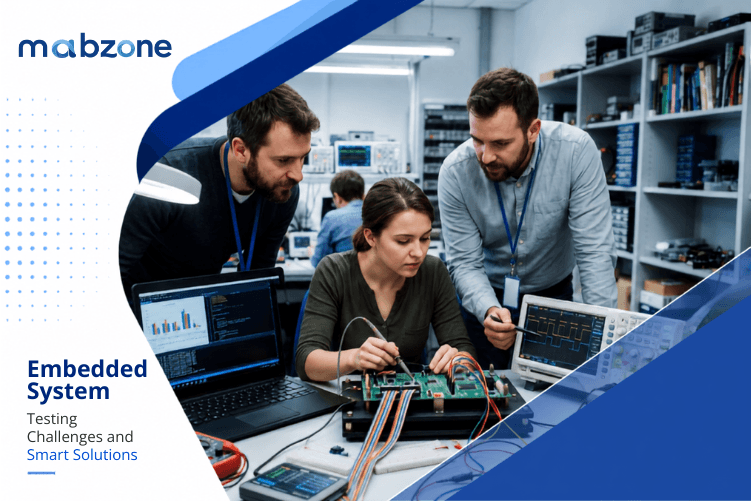
Embedded systems are all around us — found in cars, medical devices, smart TVs, and HVAC systems. Because these systems often handle vital tasks, they must operate without error. This is why testing embedded systems is so important. Reliable, efficient, and safe systems start with thorough, well-planned testing.
Yet testing embedded systems is not simple. The close link between hardware and software, the varied environments where they run, and the demand for real-time performance all create specific engineering hurdles. In this article, we look at these hurdles in depth and share practical ways engineers can overcome them.
Embedded Testing Challenge 1: Complex Hardware-Software Integration
Embedded systems sit at the crossroads of hardware and software. This close connection makes it challenging to pinpoint where a problem begins. A software bug can look like a hardware failure, and a hardware issue can appear to be a coding error — sending engineers down the wrong diagnostic path and wasting valuable development time.
Engineers can ease this problem through hardware-in-the-loop (HIL) testing. HIL lets teams simulate real hardware signals so the software can run in a near-real-world environment while remaining safe and repeatable. Keeping documentation current and fostering open communication between hardware and software teams also helps catch and fix integration problems early — before they compound into larger, harder-to-trace faults.
Embedded Testing Challenge 2: Limited Memory and Constrained Resources
Embedded devices differ from standard computers in that they often operate under tight constraints on memory, processing power, and battery life. These limits directly affect how testing can be carried out. Standard desktop testing tools usually cannot run on the target hardware, requiring entirely different approaches.
The practical course of action is to adopt lightweight testing frameworks built specifically for embedded environments. These tools consume fewer resources and can execute directly on the device itself. Testing effort should also be prioritised toward the riskiest functional areas first. In a Smart Building Management System, for example, the software responsible for detecting power outages deserves the highest priority — because a failure there carries serious downstream consequences for occupant safety and equipment integrity.
Embedded Testing Challenge 3: RTOS Timing and Real-Time Requirements
Many embedded systems — including those controlling HVAC and water treatment infrastructure — must react within strict, non-negotiable time windows. Any processing delay can lead to equipment failure, unsafe operating conditions, or regulatory non-compliance. Testing for these timing constraints demands a level of precision that general-purpose testing tools cannot provide.
To verify that timing requirements are consistently met, engineers rely on specialised instrumentation. Real-time operating system (RTOS) simulators and logic analysers capture precisely how long each process takes under varying load conditions. By incorporating time-based test scenarios into the validation suite, teams can confirm that the system responds correctly to time-critical events as it would in actual deployment.
Embedded Testing Challenge 4: I2C, SPI, UART and Multi-Protocol Testing
Embedded systems routinely communicate with sensors and peripherals through a range of protocols — I2C, SPI, UART, CAN, and Modbus among them. In smart grid and energy management applications, the complexity grows further because of the large scale of connected devices and the diversity of data types being exchanged simultaneously.
Protocol analysers and bus sniffers make this challenge manageable by providing visibility into the actual data traffic flowing between components. Mock devices and software simulators allow teams to replicate peripheral behaviour without needing all physical hardware present, enabling the creation of edge-case and stress-test scenarios that would be difficult or unsafe to reproduce on live equipment.
Embedded Testing Challenge 5: Reproducibility and Intermittent Fault Debugging
Embedded systems behave differently from software applications running on a standard PC. Environmental variables — temperature, humidity, supply voltage fluctuations, electromagnetic interference — can trigger faults that appear intermittently and are difficult to reproduce on demand. Chasing a bug that only surfaces once in a hundred thousand cycles under specific thermal conditions is a significant drain on engineering resource.
Storing both hardware and software configurations in a version control system is a foundational step toward solving this. It ensures that the same test environment is always reconstructable from a known baseline. Embedding lightweight logging systems that capture runtime telemetry allows engineers to trace the sequence of events leading to a fault after the fact — transforming previously untrackable anomalies into diagnosable, reproducible failure modes.
Embedded Testing Challenge 6: Security Testing and ISO 26262 Compliance
Embedded systems in connected applications — smart building controllers, industrial HVAC systems, energy management platforms — are now routinely exposed to the internet. This connectivity introduces cybersecurity risks that simply did not exist in isolated, legacy deployments. Simultaneously, many industry sectors impose strict regulatory frameworks that demand documented proof of safety and correctness.
Security testing is most effective when it begins with the first lines of code rather than being treated as a final-phase activity. Penetration testing, fuzz testing, and static code analysis belong in every test phase, not just the last one. Aligning with established industry standards — ISO 26262 in automotive safety systems, IEC 62304 in medical device software — ensures the final product meets regulatory requirements and can withstand scrutiny from both auditors and adversaries.
Embedded Testing Challenge 7: Scalable and Maintainable Test Architecture
As embedded systems grow more complex and more interconnected, the test infrastructure must grow with them. In large-scale deployments such as smart grids — where thousands of devices must operate in concert — scalable testing is not a convenience but a non-negotiable requirement.
A modular test architecture allows teams to distribute validation workloads across many systems without rebuilding the test suite from scratch each time the hardware evolves. Pairing this architecture with automated testing and CI/CD pipeline integration dramatically improves maintainability. Writing test scripts once, documenting them clearly, and structuring them to be readily adapted for new hardware revisions or software versions keeps the testing effort proportional as the product matures.
Embedded Testing Challenge 8: Closing the Standardisation Gap
Despite years of progress in embedded engineering practice, the field still lacks consistent, universally adopted testing standards. When every project team selects its own methods independently, results become patchy, knowledge stays siloed, and effort is duplicated unnecessarily across organisations and product lines.
The practical remedy is to develop a structured, documented testing strategy that transcends individual projects. Creating reusable test plans and documentation templates that the whole organisation can draw on is a meaningful first step. Training engineering and QA teams in embedded-specific testing methodologies brings everyone to a shared baseline. Fostering collaboration between developers, test engineers, and product stakeholders from the earliest stage of a project produces a more unified and efficient testing process overall.
Moving to Smarter Embedded System Testing
Testing embedded systems is tough, but it is also non-negotiable. As these technologies power HVAC systems, energy management platforms, smart buildings, and smart grid infrastructure, rigorous and adaptable embedded software testing strategies become more important with every product generation.
When teams understand the common hurdles and apply focused solutions — hardware-in-the-loop simulation, RTOS tooling, modular automation, and security-by-design — they can validate that embedded systems hold up under real-world deployment. At mabzone Technologies, we help embedded engineering teams build testing strategies that are systematic, scalable, and standards-aligned from day one.
Frequently Asked Questions
What is embedded system testing? Embedded system testing is the process of validating that embedded software and hardware function correctly together under real-world conditions — including timing constraints, resource limitations, protocol interfaces, environmental variation, and safety-critical requirements.
What is hardware-in-the-loop (HIL) testing? HIL testing is an embedded system testing technique where real hardware signals are simulated in a controlled environment, allowing embedded software to be tested against realistic inputs without requiring the actual physical hardware to be present. It is widely used in automotive, aerospace, and industrial automation.
What is an RTOS and why does it matter for embedded testing? A Real-Time Operating System (RTOS) is an operating system designed to process data and execute tasks within strict, deterministic time constraints. RTOS timing behaviour must be validated as part of embedded system testing to ensure the system meets its real-time requirements under all operating conditions.
How do you test embedded systems without the physical hardware? Through software simulation, hardware-in-the-loop (HIL) testing, and mock devices or bus simulators that replicate peripheral behaviour. These approaches allow testing to begin earlier in the development cycle and enable edge cases to be exercised that would be difficult or unsafe to reproduce on live hardware.
What standards apply to embedded system safety testing? Key standards include ISO 26262 for automotive functional safety, IEC 62304 for medical device software, IEC 61508 for industrial safety systems, and DO-178C for aviation software. Each standard specifies the testing rigour and documentation required for software at different safety integrity levels.