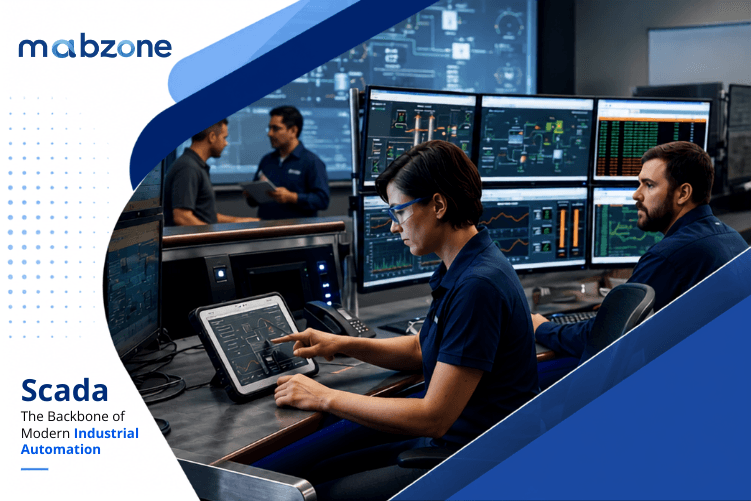
Supervisory Control and Data Acquisition — SCADA — is the nerve system powering critical infrastructure around the world. From the electricity grid feeding cities to the pipelines moving oil across continents, SCADA systems monitor, control, and optimize industrial operations at a scale that would be impossible to manage manually.
At its core, SCADA is a software and hardware framework that collects real-time data from field devices — sensors, actuators, PLCs, and RTUs — aggregates it into a central supervisory layer, and enables operators to act on that data instantly. The result is continuous visibility and control across geographically distributed assets from a single control room.
How SCADA Systems Work: RTUs, PLCs, HMIs and the Control Loop
A SCADA system consists of four key layers working in tight coordination. Field instruments — thermocouples, pressure transducers, flow meters — measure physical conditions and convert them into electrical signals. Remote Terminal Units (RTUs) or Programmable Logic Controllers (PLCs) translate those signals into digital data and execute local control logic, keeping systems running even if communications to the central host are temporarily interrupted.
A communication infrastructure — whether wired, cellular, satellite, or radio — carries data between field devices and the SCADA server. The Human-Machine Interface (HMI) at the top presents real-time process values, alarms, and historical trends on operator workstations, turning raw telemetry into actionable insight.
Modern SCADA platforms add historian databases that log every measurement for compliance and analysis, alarm management engines that filter noise from genuine faults, and increasingly, edge-computing nodes that preprocess data close to the source to reduce latency and bandwidth consumption.
SCADA for Energy Management: Grid Control and Renewable Integration
Energy utilities depend on SCADA to balance generation with demand, reroute power around faults, and maintain grid stability at all times. Advanced Distribution Management Systems (ADMS) built on SCADA foundations can model the entire distribution network in real time, automatically isolate faults, and restore power to affected customers within seconds rather than hours.
Renewable energy has made SCADA even more critical. Solar farms and wind parks are geographically dispersed and inherently variable — SCADA aggregates output from hundreds of inverters and turbines, predicts generation curves, and signals dispatchable assets to compensate for fluctuations. The integration of battery energy storage adds another control dimension that only a robust SCADA backbone can manage reliably.
Demand response programs also rely on SCADA to communicate curtailment signals to industrial consumers in real time, reducing peak load without manual intervention. The economic and grid-stability benefits are significant — and none of it is achievable without real-time telemetry and control.
SCADA for Water and Wastewater: Real-Time Monitoring and Leak Detection
Water authorities manage treatment plants, pumping stations, and distribution networks spanning hundreds of kilometres. SCADA connects every node — monitoring reservoir levels, pump pressures, chlorine dosing, and pipe flow rates continuously. Operators receive alerts the moment a reading deviates from safe limits, whether it is a pump cavitating at a remote booster station or chlorine levels drifting at a treatment point.
Leak detection is one of the highest-value SCADA applications in water networks. By comparing inflow and outflow across pressure zones in real time, the system can flag abnormal losses and pinpoint their likely location, enabling maintenance crews to act before a minor leak becomes a main break. Utilities using SCADA-based leak detection routinely reduce non-revenue water losses by 20–35 percent.
Wastewater systems benefit equally. SCADA monitors influent loads, aeration basin dissolved oxygen, and effluent quality, automatically adjusting blower speeds and chemical dosing to keep treatment within consent limits — reducing both energy consumption and compliance risk.
SCADA for Oil and Gas: Pipeline Monitoring, Leak Detection and Compliance
Upstream, midstream, and downstream oil and gas operations each present unique control challenges that SCADA addresses end to end. In upstream production, SCADA links wellhead sensors, separator controls, and custody transfer meters across fields that may span thousands of square kilometres. Remote shut-in capability — triggering emergency wellhead valves from the control room — is a safety-critical feature that protects both personnel and the environment.
Pipeline operators rely on SCADA for leak detection, pig tracking, and pressure management along thousands of kilometres of transmission infrastructure. The system continuously reconciles measured flow at each compressor or pump station against expected hydraulic models; deviations trigger immediate investigation. Regulatory bodies in most jurisdictions mandate SCADA-based leak detection on hazardous liquid and gas pipelines, making it both a safety imperative and a compliance requirement.
Downstream, refineries use SCADA integrated with Distributed Control Systems (DCS) to manage complex process units — crude distillation, catalytic cracking, hydrotreating — where hundreds of control loops must maintain tight process windows simultaneously. The combination of SCADA's wide-area visibility and DCS's precise loop control gives operators full situational awareness from the tanker berth to the product loading rack.
SCADA for Manufacturing: OEE, Predictive Maintenance and Traceability
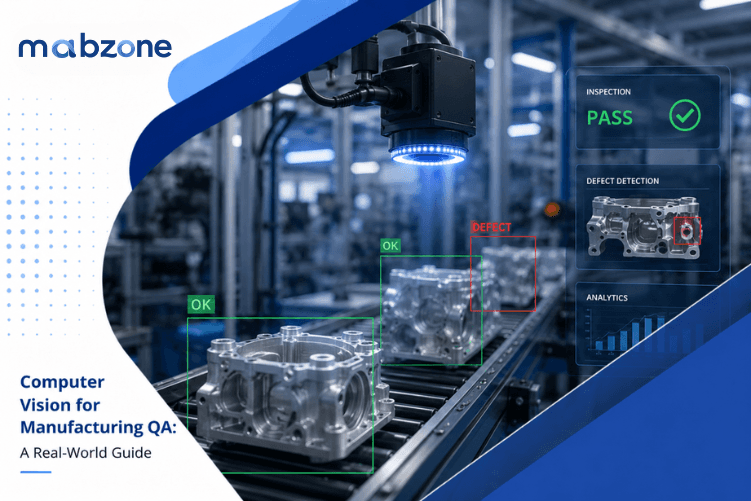
Discrete and process manufacturers use SCADA to connect the plant floor to production management. Line supervisors see OEE (Overall Equipment Effectiveness) metrics updating in real time, quality control systems flag statistical deviations before defective product reaches the end of the line, and maintenance teams receive predictive alerts when vibration signatures or temperature trends suggest impending equipment failure.
In automotive and electronics assembly, SCADA coordinates conveyors, robots, and test stations into a synchronized production sequence. Traceability requirements — knowing exactly which components went into which finished unit — are met by SCADA historians that record every process parameter against each serialized part.
Food and beverage, pharmaceutical, and specialty chemical manufacturers face additional compliance pressures. SCADA systems in these sectors generate 21 CFR Part 11-compliant audit trails and batch records automatically, replacing paper-based documentation with tamper-evident electronic records that accelerate regulatory submissions and inspections.
SCADA for Electric, Gas and Water Utilities: Smart Grid and AMI Integration
Electric, gas, and water utilities have relied on SCADA for decades, but the technology's role is expanding as infrastructure ages and expectations rise. Smart grid initiatives layer Advanced Metering Infrastructure (AMI) data onto existing SCADA systems, giving utilities granular consumption visibility down to the individual premise for the first time.
Outage management is transformed by SCADA integration with GIS and customer information systems. When a fault is detected, the system automatically identifies the affected customers, dispatches the closest available crew, and provides estimated restoration times — compressing the entire outage management cycle from hours to minutes.
For gas distribution utilities, SCADA monitors pressure across the delivery system, detects odour controller faults, and manages peak shaving operations at LNG satellite plants. Automated pressure regulation based on real-time demand forecasts reduces system stress and extends infrastructure life.
SCADA for Boilers and Chillers: Energy Optimisation in HVAC and Building Systems
Building and industrial HVAC systems represent one of the most widespread — and often underappreciated — SCADA applications. Central plant SCADA for boiler and chiller systems monitors supply temperatures, differential pressures, flow rates, and energy consumption, using that data to sequence equipment for optimal efficiency.
Chiller plant optimisation is a compelling use case. A SCADA-driven optimiser can evaluate every possible combination of chiller, cooling tower, and pump operation in real time, selecting the configuration that meets the load at minimum kW/ton. Facilities routinely achieve 15–25 percent reductions in chiller plant energy after deploying SCADA-based optimisation, with payback periods under two years.
Boiler controls benefit similarly. Combustion efficiency is maximised by continuously trimming excess air based on flue gas oxygen measurements, and SCADA historians capture the fuel consumption and steam output data needed for emissions reporting and boiler efficiency certificates.
The Future of SCADA: Cloud, Edge AI, Cybersecurity and Digital Twins
The next generation of SCADA is converging with cloud computing, edge AI, and cybersecurity frameworks in ways that are redefining industrial automation. Cloud-hosted SCADA platforms eliminate the cost and complexity of on-premises server infrastructure while providing enterprise-grade availability, automatic updates, and seamless integration with ERP and analytics platforms.
Edge AI is moving intelligence closer to the physical process. Rather than streaming raw sensor data to a central server for analysis, edge nodes now run machine learning models locally — detecting anomalies, predicting failures, and even recommending control adjustments without introducing communication latency. This is particularly valuable in remote or bandwidth-constrained environments.
Industrial cybersecurity has become inseparable from SCADA strategy following high-profile incidents that demonstrated the real-world consequences of compromised operational technology. Modern SCADA deployments implement network segmentation, encrypted communications, role-based access control, and continuous threat monitoring as baseline requirements rather than optional additions.
Digital twin integration is the most transformative development on the horizon. A physics-based digital twin synchronized with real-time SCADA data allows operators to simulate process changes before implementing them, train new operators in a risk-free environment, and run what-if scenarios that would be impossible on live plant. As digital twin technology matures, the boundary between simulation and the physical process will blur — making SCADA the real-time data spine that keeps both worlds aligned.
For organisations that depend on continuous industrial operations, SCADA is not simply an automation tool — it is the foundational layer on which safety, efficiency, and resilience are built. Investing in modern, well-integrated SCADA systems is one of the highest-return decisions an industrial operator can make.
Frequently Asked Questions About SCADA Systems
What does SCADA stand for and what does it do? SCADA stands for Supervisory Control and Data Acquisition. It is a software and hardware framework that collects real-time data from field devices — sensors, PLCs, and RTUs — across geographically distributed industrial assets, presents that data to operators via an HMI, and enables remote control and automated responses. SCADA is used across energy, water, oil and gas, manufacturing, and utilities.
What is the difference between SCADA and a PLC? A PLC (Programmable Logic Controller) executes local control logic at the field level — maintaining a specific process variable, triggering an output when a threshold is reached. SCADA operates at the supervisory level — it aggregates data from many PLCs, presents a unified operational view, records historical data, and enables operators to issue commands across the whole system. PLCs are a component within a SCADA architecture, not a replacement for it.
How is SCADA used in the energy sector? In energy, SCADA systems monitor and control power generation assets, transmission and distribution networks, and renewable energy installations. Advanced Distribution Management Systems (ADMS) built on SCADA enable automatic fault isolation and power restoration, demand response programme management, and real-time balancing of renewable generation variability. SCADA is also central to smart grid programmes that incorporate Advanced Metering Infrastructure (AMI) data.
What are the cybersecurity risks for SCADA systems? SCADA systems were originally designed for isolated operational networks and can be vulnerable when connected to enterprise IT networks or the internet. Key risks include remote exploitation of unpatched software, insufficient authentication on HMI and engineering workstations, lack of encryption on legacy communications protocols, and insufficient network segmentation between IT and OT environments. Modern SCADA deployments implement defence-in-depth: network segmentation, encrypted communications, role-based access control, and continuous OT-specific threat monitoring.
What is the difference between SCADA and DCS? SCADA is designed for wide-area monitoring and control across geographically distributed assets — pipelines, power grids, water networks. A Distributed Control System (DCS) is designed for tight, continuous process control within a single plant, executing hundreds of control loops with low latency. In practice, refineries and large industrial facilities often run both: DCS for precise process unit control and SCADA for plant-wide visibility and integration with business systems.