Autonomous systems are no longer a future consideration for industrial operators — they are an operational reality that is reshaping how work gets done across manufacturing, logistics, energy, construction, and agriculture. Robotics and drone technology have matured from controlled-environment demonstrations into field-deployable systems that operate alongside human workers, handle tasks that are dangerous or physically impossible for people, and generate data that drives smarter decisions across the entire operation.
Understanding where these technologies deliver genuine value — and where the engineering requirements for reliable deployment are often underestimated — is the starting point for any organisation evaluating autonomous systems seriously.
Industrial Robotics in 2026: Cobots, AMRs and Vision-Guided Manipulators
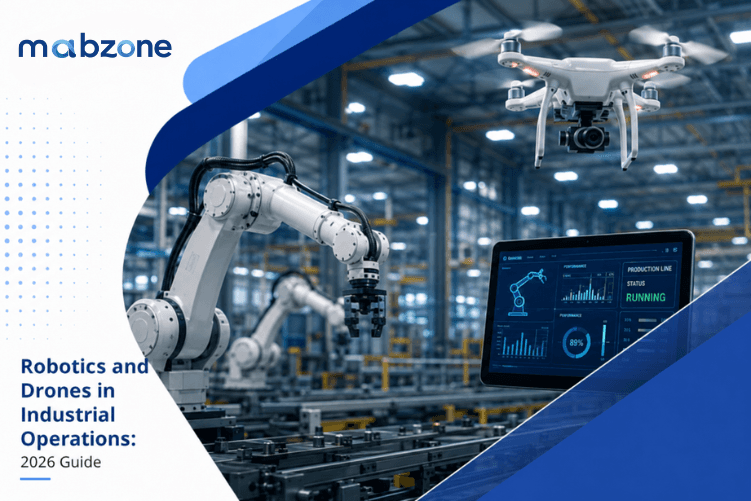
Industrial robotics has existed in manufacturing for decades, but the systems being deployed today are fundamentally different from the fixed, single-task robots that dominated factory floors in the 1990s and 2000s. Collaborative robots — cobots — are designed to work in shared space with human operators without safety cages, equipped with force-torque sensing that stops motion the instant unexpected contact is detected. This removes the traditional trade-off between automation and workplace flexibility.
Mobile autonomous robots are navigating dynamic warehouse and factory environments using simultaneous localisation and mapping — building and updating a real-time model of their environment as they move through it. Unlike AGVs that follow fixed tracks or magnetic floor strips, modern AMRs recalculate routes in response to obstacles, traffic, and changing layouts without human intervention. The operational flexibility this enables has transformed fulfilment operations at a scale that would have required complete floor redesigns a decade ago.
Manipulator arms equipped with advanced vision systems and force feedback are now performing assembly tasks that previously required human dexterity — inserting connectors, handling irregular components, and adapting grip force in real time based on the sensed weight and compliance of the object. The combination of vision, force sensing, and real-time control is what makes these systems viable for the irregular, variable workloads that characterise real manufacturing rather than idealised production environments.
Industrial Drone Applications Delivering Measurable ROI
Drone technology has followed a parallel trajectory — moving from hobbyist and photography applications into rigorous industrial deployment where reliability, data quality, and integration with operational systems are the criteria that matter.
Infrastructure inspection is the application where drones have produced the clearest and most consistent returns. Inspecting a transmission tower, a wind turbine blade, a bridge deck, or a storage tank previously required access equipment, scaffolding or rope access teams, and significant scheduling complexity around weather windows and operational shutdowns. A drone equipped with a high-resolution camera, thermal sensor, or LiDAR scanner can complete the same survey in a fraction of the time, at a fraction of the cost, without requiring the asset to be taken offline.
In oil and gas, drones are conducting flare stack inspections and pipeline corridor surveys that would otherwise require helicopter charters or extended rope access campaigns. The data quality is comparable or superior — a drone can hold position precisely and capture imagery from angles that a helicopter cannot safely approach — and the repeatability of autonomous flight paths means that comparison between inspection cycles is systematic rather than dependent on individual operator judgment.
In agriculture, fixed-wing and multirotor drones equipped with multispectral sensors are mapping crop health, soil moisture variation, and irrigation uniformity across areas that no ground team could survey at equivalent resolution and frequency. The analytics generated from repeated surveys over a growing season allow farmers to apply inputs where they are needed and withhold them where they are not — a precision that translates directly into yield improvement and input cost reduction.
What Industrial Robotics and Drone Deployment Actually Requires to Succeed
The gap between a drone or robot that works in a demonstration and one that works reliably in an industrial deployment is an engineering gap, not a technology gap. The technology is capable. The question is whether the surrounding systems — data pipelines, integration with operational software, maintenance infrastructure, operator training, and safety frameworks — are designed to the same standard as the hardware itself.
Reliability in industrial environments demands more than the reliability specifications that consumer or prosumer drones are designed to meet. Temperature extremes, electromagnetic interference from industrial equipment, GPS-denied environments inside structures or in dense urban areas, and the consequence severity of failures that could damage assets or injure workers all require that the system is selected, configured, and operated to a higher standard than a general-purpose commercial product.
Data management is frequently the bottleneck that limits the value extracted from drone surveys. A single LiDAR survey of an industrial facility can generate hundreds of gigabytes of point cloud data. Without a processing pipeline that converts raw sensor data into actionable outputs — annotated inspection reports, change detection overlays, structural analysis models — the data sits on drives and the inspection cycle produces less value than it could.
Human-Robot Collaboration: Why Cobots Outperform Full Automation
The framing of robotics and drones as replacements for human workers is both economically and operationally inaccurate for most industrial deployments. The systems that deliver the most value are those designed from the outset as collaborative — combining the consistency, precision, and endurance of autonomous systems with the judgment, adaptability, and contextual knowledge of experienced operators.
Cobots that handle the physically demanding or repetitive elements of an assembly task while a human operator handles fit, judgment calls, and quality verification are more productive as a combined system than either would be alone. Drones that conduct routine surveys and flag anomalies for expert human review produce better inspection outcomes than purely manual inspection programmes, because the drone ensures complete, consistent coverage while the human expert focuses attention on the findings that require genuine analysis.
This collaborative model also addresses the workforce dimension of autonomous system adoption. Rather than replacing roles, the most successful deployments create new specialist roles — robot operators, drone pilots, data analysts, systems integrators — that draw on the expertise of the workers who previously performed the physical tasks. The transition requires investment in training and a genuine organisational commitment to managing it thoughtfully, but the outcome is a more capable workforce operating more capable tools.
Drone and Robotics Regulations: Safety Standards and BVLOS Compliance
Drones operating beyond visual line of sight, robots operating in shared human workspaces, and autonomous vehicles operating on public infrastructure all function within regulatory frameworks that are evolving rapidly and vary significantly by jurisdiction. Understanding the current regulatory landscape and building systems that are designed to operate within it — rather than retrofitting compliance after the fact — is a prerequisite for any deployment that involves safety-critical operations.
In aviation, BVLOS operations require specific approvals that depend on operational risk assessments, detect-and-avoid capability, and demonstrated reliability records. In manufacturing, collaborative robot installations are governed by standards including ISO 10218 and ISO/TS 15066, which define the risk assessment process, safety function requirements, and permitted human-robot proximity under different operating conditions. These standards exist because the consequences of getting the safety analysis wrong are serious, and navigating them requires engineering expertise that goes beyond the hardware selection decision.
Integrating Robotics and Drones With SCADA, MES and ERP Systems
Autonomous systems do not operate in isolation from the rest of an industrial operation. The data they generate, the commands they receive, and the alerts they produce need to flow through the same operational infrastructure — SCADA systems, MES platforms, ERP systems, maintenance management software — that coordinates the rest of the facility.
Integration at this level requires both technical capability and domain knowledge. The technical challenge is connecting systems that were not designed to communicate with each other, often across different generations of technology and different networking architectures. The domain knowledge challenge is understanding which data flows actually matter to operations — what does the maintenance team need from a drone inspection to make a repair decision, what does the production management system need from a robot to update its schedule — and designing the integration around those operational realities rather than around what is technically convenient to expose.
Building the Business Case for Industrial Robotics and Drone Investment
The strongest business cases for robotics and drone deployment rest on a combination of cost reduction, capability expansion, and risk reduction — and the relative weight of each depends on the specific application and the organisation's operational priorities.
Cost reduction cases are most straightforward where autonomous systems replace high-cost manual processes with clear unit economics — inspection campaigns, repetitive assembly operations, inventory counting cycles. Capability expansion cases are compelling where autonomous systems enable operations that were previously impractical — continuous structural monitoring, inspection of assets that cannot be safely accessed by human teams, precision agriculture at scales that ground equipment cannot cover. Risk reduction cases often carry the highest long-term value but require more sophisticated modelling — the avoided cost of a safety incident, a regulatory penalty, or a catastrophic asset failure prevented by earlier detection.
At mabzone Technologies, we design and deploy robotics and drone systems across manufacturing, infrastructure, energy, and agriculture applications. Our approach starts with the operational problem rather than the technology — identifying where autonomous systems create genuine value in your specific context, designing the surrounding data and integration infrastructure to capture that value, and building the reliability and safety framework that industrial deployment demands. If you are evaluating where autonomous systems fit in your operations, we would welcome the conversation.
Frequently Asked Questions About Industrial Robotics and Drones
What are collaborative robots (cobots) and how do they differ from traditional industrial robots? Collaborative robots — cobots — are designed to work safely in shared space with human operators without safety cages or barriers. They use force-torque sensing and speed-monitoring to detect unexpected contact and stop motion immediately. Traditional industrial robots operate at high speed inside physical safety enclosures, separated from humans during operation. Cobots are generally slower and lighter than traditional industrial robots but offer far greater deployment flexibility — they can be redeployed to new tasks without redesigning the workspace.
Where do industrial drones deliver the clearest return on investment? Infrastructure inspection delivers the most consistent and measurable ROI: transmission towers, wind turbine blades, bridge decks, storage tanks, flare stacks, and pipeline corridors. Drones complete inspections faster, more safely, and more cost-effectively than access equipment or rope access teams, and autonomous repeat flight paths make cycle-to-cycle comparison systematic. Precision agriculture — multispectral crop health mapping — is the other high-ROI application, delivering measurable yield improvement through targeted input application.
What regulations govern industrial drone operations? Regulations vary by jurisdiction. In most countries, drone operations fall under civil aviation authority oversight. Operations beyond visual line of sight (BVLOS) require specific approvals based on operational risk assessments, detect-and-avoid capability, and demonstrated reliability. In manufacturing environments, collaborative robot installations are governed by ISO 10218 (robot safety requirements) and ISO/TS 15066 (collaborative robot speed and force limits). Building regulatory compliance into the system design from the start — rather than retrofitting it — is essential for safety-critical deployments.
How do autonomous mobile robots (AMRs) differ from automated guided vehicles (AGVs)? AGVs follow fixed routes defined by floor tracks, magnetic strips, or embedded wires — they cannot deviate from the prescribed path when obstacles are encountered. AMRs use SLAM (Simultaneous Localisation and Mapping) to build real-time maps of their environment and dynamically recalculate routes around obstacles, people, and layout changes. AMRs are more expensive but offer significantly greater operational flexibility for environments with variable layouts or high foot traffic.
What is the typical ROI timeline for industrial robotics deployment? ROI timelines vary widely by application. High-volume, repetitive assembly automation in manufacturing typically achieves payback in twelve to twenty-four months. Drone inspection programmes replacing helicopter charters or rope access campaigns often see payback within six to twelve months. AMR deployments in fulfilment operations typically achieve payback in eighteen to thirty months. The business case for safety-critical applications — preventing a single serious incident or regulatory penalty — can justify deployment even where the operational cost savings alone would not.