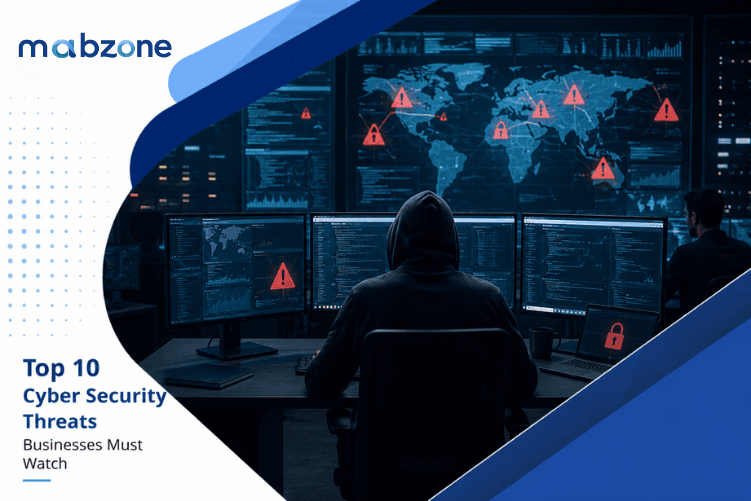
In a marketplace where economic activity is increasingly mediated by digital information, cybersecurity has transcended the status of a supplementary measure and has asserted itself as a core requirement for continued operational viability. The adaptive capability of malicious actors is growing commensurately, the sophistication and orchestration of cyber-operations escalate annually, and the financial consequences of data breaches amplify in parallel. At present, vigilance is the singular and shared obligation of enterprises ranging from nascent startups to the largest multinationals.
This guide catalogs the ten paramount cybersecurity threats enterprises are compelled to monitor rigorously in 2025. A granular and anticipatory comprehension of these hazards will enable the construction of calibrated defensive postures, the preservation of proprietary and customer information, and the reinforcement of consumer confidence in corporate stewardship.
Ransomware Attacks: How Cybercriminals Hold Business Data Hostage
Ransomware persists as the prevailing concern in the cybersecurity record. The operational logic is unchanged: adversaries encrypt the target's digital repositories and demand monetary compensation as the exclusive condition for restoration. The proliferation of Ransomware-as-a-Service (RaaS) marketplaces has democratised the capability, permitting less-experienced actors to orchestrate catastrophic episodes.
Consequences extend beyond immediate financial depletion to include substantive erosion of corporate reputation, leadership credibility, and client loyalty. Effective defence mandates immutable offsite data preservation, persistent security awareness programmes for personnel, and comprehensive endpoint detection platforms. Transitioning to a zero-trust architecture reduces the exploitable attack surface and the opportunity for successful ransomware deployment.
Phishing and Spear Phishing: The Most Common Cybersecurity Threat
Phishing endures as the predominant initial compromise technique, now presented in ever more refined forms. Attackers combine well-crafted email campaigns, fraudulent websites, and synthetic voice synthesis to coax personnel into surrendering credentials or activating harmful links.
While perimeter filters and advanced email gateways provide some barrier, human cognition remains the most vulnerable vector. Systematic phishing exercises and repeated awareness programmes demonstrably curtail susceptibility, warranting integration into every organisation's risk-management routine.
Insider Threats: When the Cybersecurity Risk Comes From Within
Threat vectors do not reside solely outside the organisation. Disgruntled employees, visiting contractors, and inadvertent users alike can inflict grave damage through the misuse of legitimate credentials — rendering perimeter countermeasures ineffective.
Mitigation requires tight entitlement governance, continuous activity surveillance, and strict adherence to the least-privilege doctrine. Correlating behavioural metrics with audit logs can flag anomalous deviations in a timely fashion before damage compounds.
Cloud Misconfiguration: The Hidden Cybersecurity Vulnerability in 2025
Accelerated migration to cloud environments has revealed leverageable misconfigurations. Improperly secured storage containers, inadequately protected APIs, and lax identity stewardship together present pathways to sensitive-information compromise.
Given the cloud model of shared responsibility, each organisation must independently secure data, middleware, and identity access. Reliance upon integrated security platforms and the compulsory deployment of multifactor authentication have transitioned from recommendation to operational necessity.
Supply Chain Cyberattacks: Infiltrating Businesses Through Trusted Vendors
Criminal ecosystems are systematically exploiting vendors, software distributors, and third-party services to proxy into larger enterprises. The SolarWinds incident continues to serve as a defining case, illustrating the cascading consequences of tampering with the software delivery process.
Enterprises must institutionalise expansive due diligence, enforce precise security requirements in supplier contracts, and maintain continuous oversight of third-party behaviour. The lax controls of a single partner can invalidate the threat model of the entire ecosystem, creating a domino effect extending to customers and stakeholders.
IoT Security Vulnerabilities: Every Connected Device is an Attack Surface
The proliferation of IoT devices — from smart CCTV arrays to factory-floor sensors — has greatly enlarged the attack surface of contemporary organisations. Many devices ship with inadequate firmware defences, minimal maintenance paths, and non-encrypted communication protocols.
Adversaries convert these under-protected endpoints into launch pads for lateral movement. Compensating controls encompass strict network segmentation for IoT zones, systematic firmware hygiene, and the deployment of multifactor validation regardless of presumed device trust.
AI-Powered Cyberattacks: How Hackers Are Using Machine Learning Against You
Artificial intelligence, originally positioned as an enabler of commercial scale, is simultaneously supercharging offensive operations. Machine learning systems automate attack sequencing, enable rapid credential speculation, and fabricate extraordinarily credible yet deceptive communications — whether textual, audio, or visual.
Defending against AI-augmented threats necessitates equally sophisticated defensive machinery. Techniques such as advanced anomaly detection, contextual behavioural profiling, and orchestration-driven autonomous mitigation are no longer optional — they are core components of an adequate modern security posture.
Zero-Day Exploits: Cyberattacks That Strike Before Any Patch Exists
A zero-day exploit operates against previously undetected vulnerabilities, permitting an attacker to commandeer a system before the software manufacturer can issue a fix. Because no detection signatures exist and the exploit precedes any defensive update, conventional perimeter devices frequently fail.
Mitigation effectiveness is enhanced by maintaining an aggressive patching schedule, consuming contextualised threat intelligence feeds, and embedding network and host-based intrusion detection mechanisms that are sensitive to deviant behavioural signatures — independent of the exploit's technical blueprint.
Business Email Compromise (BEC): The Costliest Cybercrime Affecting Businesses
In contrast to general phishing, Business Email Compromise employs deep contextual intelligence to replicate a senior officer's communicative and decisional style. Compromise is achieved via social engineering rather than malware, and the goal is capital flight or corporate espionage via coercive instruction.
Global losses from BEC now exceed billions of dollars annually. Defensive architecture must include mandatory user training reinforced by contextualised simulations, cryptographic domain verification via SPF, DKIM, and DMARC, and the strict enforcement of dual-authority out-of-band validation for any monetary transaction or sensitive file transfer.
DDoS Attacks: How Cybercriminals Take Down Business Operations
A Distributed Denial-of-Service engagement floods an enterprise's network or application layer with illegitimate traffic, rendering legitimate user access impossible. Some DDoS attacks are employed as masking strategies to conceal concurrent, more subtle infiltrations; others are purely disruptive and designed to halt ongoing operations.
Effective mitigation encompasses externally sourced traffic scrubbing, rate-limiting at multiple layers, and elastic response capacity that activates additional infrastructure under conditions of extreme anomaly. For firms operating e-commerce or service-oriented platforms, investment in redundancy and DDoS-specific defensive architecture is a prerequisite for preserving service availability.
Building a Cybersecurity Strategy That Keeps Pace With Evolving Threats
Cybersecurity posture cannot be treated as a static capital outlay — it constitutes a perpetual operational commitment. The threat landscape in 2025 is more fluid and aggressively orchestrated than at any prior point. To maintain defensive integrity, organisations should implement a zero-trust architectural framework, engage personnel in recurring security awareness training, allocate funds towards AI-enhanced defensive instrumentation, schedule periodic red-teaming and vulnerability assessments, and forge strategic alliances with accredited managed security service firms.
At mabzone Technologies, we provide end-to-end assessment of threat exposure, the design and deployment of multilayered defensive architectures, and ongoing threat intelligence integration to ensure that client security postures remain ahead of the evolving adversary landscape.
Frequently Asked Questions About Cybersecurity Threats
What is the most common cybersecurity threat for businesses in 2025? Phishing remains the most prevalent initial attack vector, responsible for the majority of data breaches across all business sizes. Attackers combine targeted spear phishing emails, fraudulent websites, and voice synthesis to trick employees into surrendering credentials — making regular security awareness training the most cost-effective defence investment any organisation can make.
How can businesses protect against ransomware attacks? Effective ransomware defence requires a layered approach: immutable offsite backups that cannot be encrypted by an attacker, a zero-trust network architecture that limits lateral movement after initial compromise, endpoint detection and response (EDR) tools, and regular phishing and social engineering training. Ransomware-as-a-Service has made ransomware accessible to low-skill attackers, so the protection bar must be raised accordingly.
What is a zero-day exploit and why is it dangerous? A zero-day exploit targets a previously unknown software vulnerability — meaning no patch exists at the time of attack. Because no detection signatures have been published, traditional antivirus tools cannot identify the exploit. Defence relies on behavioural anomaly detection, aggressive patching cycles to reduce the window after disclosure, and network segmentation that limits damage even when a host is compromised.
How does Business Email Compromise (BEC) differ from phishing? Unlike phishing, which casts a wide net, BEC is highly targeted. Attackers research a specific organisation, impersonate a senior executive or trusted supplier, and use social engineering — not malware — to instruct employees to transfer funds or share sensitive data. BEC bypasses technical security controls because it exploits trust, not software vulnerabilities. SPF, DKIM, and DMARC email authentication combined with out-of-band verification for financial transactions are essential controls.
What cybersecurity measures should every business have in place? Every business should implement multi-factor authentication across all systems, maintain regular and tested backups, deploy endpoint detection tools, conduct quarterly security awareness training, enforce least-privilege access controls, and have an incident response plan documented and rehearsed. Businesses handling sensitive data should additionally conduct annual penetration tests and consider a managed security service provider (MSSP) for continuous monitoring.